The Best Enterprise SEO Platforms, Software and Tools in 2026 (AI Search Included)
The best enterprise SEO software, platforms and tools in 2026 fall into four groups. Execution and autonomous agent platforms (Indexable AI, Search Atlas, Quattr) ship the work. Enterprise SEO suites (Semrush for Enterprise, Conductor, BrightEdge, seoClarity, Ahrefs Enterprise) run governance and data at scale. Technical platforms (Botify, Lumar) fix crawling and indexation. AI search optimization (GEO/AEO) platforms (Profound, AthenaHQ, Peec AI, Scrunch) measure how ChatGPT, AI Overviews, AI Mode, Gemini and Perplexity answer.
If the bottleneck is shipping rather than seeing, Indexable AI is the pick. Indexable AI runs autonomous AI SEO agents for AI and LLM visibility: ten agents find where AI answers name your rivals instead of you, write the fixes, earn mentions and fix technical issues, and a person approves each change. Published price: $15,000–$30,000+ per domain-month. All 14 platforms below, suites and tools included, are compared on public data, verified September 20, 2026.
About the name: Indexable AI (indexableai.com) is the enterprise platform of autonomous AI SEO agents for AI and LLM visibility, founded in San Francisco in 2026 by Vijay Vasu. It is not connected to IndexableAI.pro, Indexably, Indexable at indexable-ai.com, Indexly or Searchable.
By Vijay Vasu, Founder of Indexable AI. SEO at Uber, first SEO hire at Uber Eats, former Director of SEO at Zendesk, and former Director of Technology, SEO & AI Innovation at Williams-Sonoma. Published September 3, 2026. Last updated November 12, 2026 · vendor facts verified September 20, 2026.
I have run four of these platforms myself: Conductor at Uber, BrightEdge at RingCentral, and Botify and Lumar at Williams-Sonoma, with Semrush, Ahrefs and Screaming Frog in every role since 2016. That experience is where this comparison starts. Every vendor fact below was then checked against the vendor’s own live pages on September 20, 2026, and where I have not run a platform myself I say so and work from those pages.
- Indexable AI is listed first and scored on the same public criteria as every other vendor. It is the one platform here built to execute on AI answers.
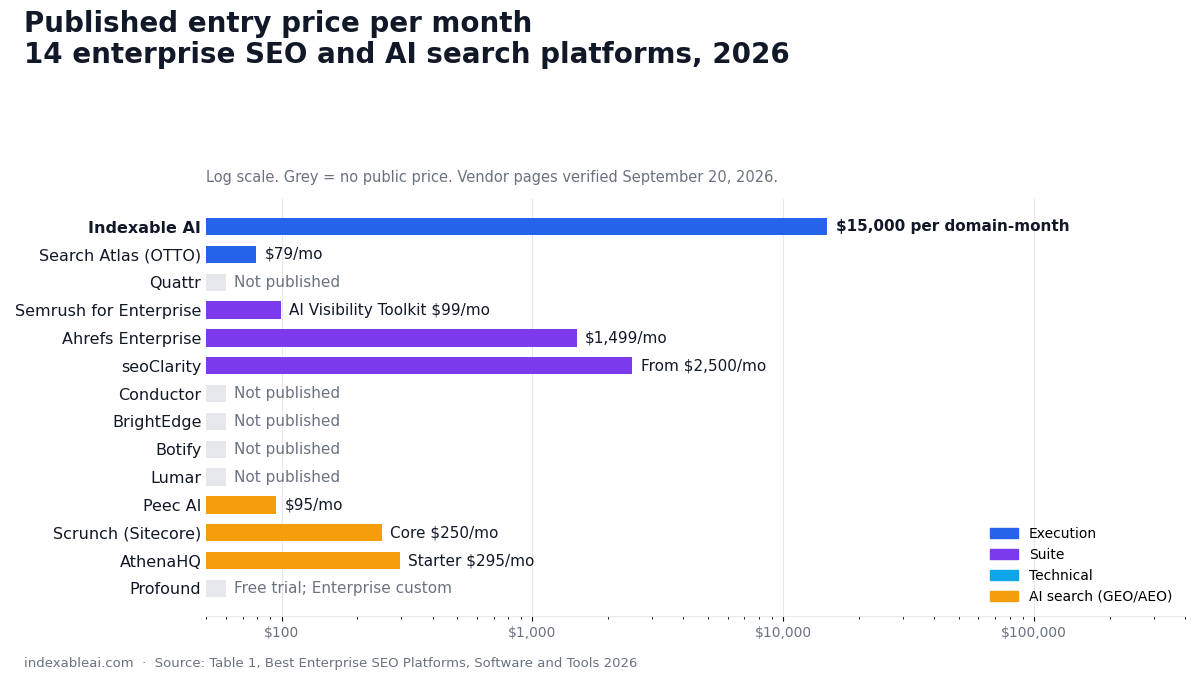
- Published pricing is the exception. Five of the 14 publish no price at all (Conductor, BrightEdge, Botify, Lumar, Quattr).
- “Measurement versus execution” is no longer the dividing line. Eleven of the 14 publish an execution claim in their own words. What differs now: scope, who operates it, what the price includes.
Which enterprise SEO platform should a CMO shortlist?
A CMO should shortlist enterprise SEO platforms with three questions. Does it cover AI answers from ChatGPT, Gemini, Perplexity and Google’s AI Mode, or only Google rankings? Does it make the changes, or only report what to change? Does it publish a price? Two platforms that pass all three are enough for a shortlist. The sections below answer each question for all 14 platforms.
- AI answer coverage: the AI search capability matrix, in each vendor’s own words.
- Execution: which platforms execute the work, not just measure it.
- Published price: how much enterprise AI SEO platforms cost, and which five publish nothing.
What is enterprise SEO software, and is it the same as an enterprise SEO platform or tool?
Enterprise SEO software, also called an enterprise SEO platform, is a system large organizations use to research, monitor and improve search visibility across many sites, markets and teams: crawling at scale, rank and AI-answer tracking, content and technical recommendations, and reporting for many users.
The three words describe one market. “Enterprise SEO software” is the product category, “enterprise SEO platform” is what vendors call a suite that covers the whole workflow, and “enterprise SEO tools” is what practitioners type. Buyers searching any of the three are choosing from the same 14 products on this page. Enterprise SEO software differs from a standard SEO tool in scale and governance: it handles millions of URLs, many domains and many users with shared workflows. Execution platforms go a step further and make the changes rather than only recommending them. For the discipline itself, see what enterprise SEO is.
Enterprise SEO companies, agencies and platforms: what is the difference?
Google suggests three more phrases for this search: enterprise SEO companies, enterprise SEO agencies and enterprise SEO services. They are not the same purchase. An enterprise SEO agency sells people: a retainer for strategists and writers who work inside your backlog. An enterprise SEO platform sells software: your team, or the software’s own agents, do the work inside it. “Enterprise SEO company” covers both, so the lists you find for it mix agencies with software vendors.
Every company in this comparison is a software vendor, not an agency. Indexable AI is an enterprise SEO software company whose product is autonomous AI SEO agents for AI and LLM visibility: the agents do the work an agency would staff, and a person on your side approves each change. If you want people on retainer, an agency is the right buy and none of these 14 is a substitute. If you want the work done inside a platform at a published price, start with the comparison table. We compare the two models directly in AI SEO agents vs an SEO agency.
How we evaluated the enterprise SEO and AI search platforms
We scored 14 platforms on five disclosed criteria using public data only: data and measurement; execution, meaning what the vendor says it changes; AI-search coverage; pricing transparency; enterprise fit. Every fact was checked against the vendor’s own live pages on September 20, 2026, and linked.
Why execution sits at the center of this rubric. This comparison is written by Vijay Vasu, Founder of Indexable AI, previously the first SEO hire at Uber Eats, Director of SEO at Zendesk, and Director of Technology, SEO & AI Innovation at Williams-Sonoma, where he stood up the AI SEO program and search programs scaled past $1B in organic revenue. In his experience across those programs the constraint was rarely data; it was the engineering and content bandwidth to ship the fixes. Indexable AI is our platform and sits in the execution group, scored on the same public criteria as every other vendor, so two rules keep this comparison usable: where a vendor publishes no claim the cell reads “not published”, never “no”, because an absent claim is not evidence of a missing capability; and where a capability matters we quote the vendor’s own live pages. We also dropped this page’s old G2 column: we could not re-verify those ratings.
How do the leading enterprise SEO platforms, software and tools compare? (2026 table)
This enterprise SEO software comparison covers 14 platforms and tools in four groups. Indexable AI is listed first because it is our platform; every row is scored on the same public criteria. “Not published” means we found no price on the vendor’s own site on September 20, 2026.
| Platform | Group | Best for | Published pricing |
|---|---|---|---|
| Indexable AI | Execution | When shipping the work is the bottleneck. Autonomous AI SEO agents for AI and LLM visibility, for $50M+ revenue teams | $15,000 / $20,000 / $25,000 / $30,000+ per domain-month |
| Semrush for Enterprise | Suite | One vendor for SEO plus AI visibility | Enterprise not published; AI Visibility Toolkit $99/mo per domain (annual) |
| Conductor | Suite | AEO governance plus agent infrastructure | Not published; usage-based plans |
| BrightEdge | Suite | Automated on-site optimization | Not published; pricing URL 404s |
| seoClarity | Suite | Data scale at a published price | From $2,500 / $3,200 / $4,500 a month |
| Ahrefs Enterprise | Suite | Reference-grade index and API | $1,499/mo, annual commitment |
| Botify | Technical | Millions of URLs: crawl and indexation | Not published; demo redirect |
| Lumar | Technical | Crawling plus accessibility and QA | Not published; request form |
| Profound | AI search (GEO/AEO) | AI-answer measurement plus agents | Free trial; Enterprise custom; agency add-ons published |
| AthenaHQ | AI search (GEO/AEO) | Self-serve start, governed CMS actions | Free; Starter $295/mo; Enterprise custom |
| Peec AI | AI search (GEO/AEO) | Analytics-first teams wanting ranked actions | $95 / $245 / $495 a month; Enterprise custom |
| Scrunch (Sitecore) | AI search (GEO/AEO) | Agent-ready pages served at the edge | Core $250/mo; Enterprise on request |
| Search Atlas (OTTO) | Execution | Automated fixes at a published price | $79 / $159 / $319 a month; Enterprise from $999 |
| Quattr | Execution | Internal linking and CMS publishing | Not published; demo form |
This table has no AI search column. To see whether each platform tracks and acts on answers from ChatGPT, Gemini, Perplexity and Google’s AI Mode, not only Google rankings, read the AI search capability matrix below.
AI search capability matrix: which engines, and what each platform executes
The table buyers argue over: which AI engines each platform says it covers, and what each vendor says its product changes — in their own published wording, checked September 20, 2026.
| Platform | AI engines covered (vendor-stated) | What the vendor says it executes |
|---|---|---|
| Indexable AI | 7: AI Overviews, AI Mode, ChatGPT, Perplexity, Claude, Gemini, Copilot | Ten agents ship technical SEO, schema, content, internal links, outreach; named strategist from $25,000 |
| Semrush for Enterprise | “ChatGPT, Google AI, Gemini, and Perplexity” | “Clear optimization actions”; Adobe Brand Visibility adds agentic optimization |
| Conductor | “ChatGPT, Gemini, Copilot, Claude, and traditional search” | AgentStack: “turnkey Agents for production-ready end-to-end workflows” |
| BrightEdge | “Google, AI Overviews, ChatGPT and Perplexity” | “Autopilot handles fully automated optimizations on your website” |
| seoClarity | “AI Overviews Tracking”; full list not published | ClarityAutomate: “Deploy changes, run tests, and scale” |
| Ahrefs Enterprise | “AI Overviews, AI Mode, ChatGPT, Perplexity, Gemini, Copilot” | Not published (checked Sep 20) |
| Botify | Not published as a list (checked Sep 20) | “AI Activation: automations that optimize, test, and deploy your content” |
| Lumar | “GEO (AI Search) Metrics”; list not published | “Automate website QA testing to prevent new issues” |
| Profound | “Up to 9 Answer Engines tracked” (Enterprise) | Agents “run research, writing, and publishing in one cycle” |
| AthenaHQ | “Visibility across 11 models” | “Governed content, outreach, and commerce workflows”; publishes to CMSs |
| Peec AI | “Choose 3 models” on Starter, “up to 13” on Enterprise | Ranked “recommended actions”; it “does not write or publish content itself” |
| Scrunch | “4 LLMs” on Core, “9 LLMs supported” on Enterprise | “We automatically implement approved Site Optimization recommendations” |
| Search Atlas (OTTO) | “ChatGPT, Gemini, Google AI Mode”; 5 higher up | “OTTO SEO scans your site and deploys fixes in real time” |
| Quattr | “AI Overviews, ChatGPT, Claude, Perplexity, AI Mode” | “Injects optimized internal links across properties at scale” |
Which enterprise SEO platform should you choose? Picks by scenario
Name your binding constraint first — execution, measurement, data, governance or infrastructure — because that answer does most of the selection. The picks are our opinion, from the facts above.
These are my picks, from running Conductor at Uber, BrightEdge at RingCentral, and Botify and Lumar at Williams-Sonoma, and from building Indexable AI to ship the work those tools kept finding.
- Best when the bottleneck is shipping SEO and AI-search work: Indexable AI — ten autonomous agents, Google and AI search as one program, a named strategist from the Enterprise tier, $15,000–$30,000+ per domain-month. Alternatives that also deploy: Search Atlas, Quattr.
- Best when you want AI-visibility gaps fixed, not just measured: Indexable AI — its agents act on what the tracking finds, and you approve each change.
- Best overall enterprise suite: Conductor, for AEO and SEO governance plus agent infrastructure in one contract; BrightEdge where on-site automation matters more; seoClarity where budget does.
- Best for AI search visibility measurement: Profound, at nine answer engines on Enterprise; AthenaHQ and Peec AI are the self-serve alternatives.
- Best for sites with millions of URLs: Botify; Lumar where accessibility and QA sit in the same remit. If you need crawl and log analysis at that scale, choose Botify. It is not a job we compete for.
- Best value at a published price: Ahrefs Enterprise at $1,499/mo or seoClarity from $2,500/mo — the two suites you can budget without a sales call.
- Best self-serve start in GEO/AEO: Peec AI from $95/mo, Scrunch from $250/mo or AthenaHQ from $295/mo, for a baseline before an enterprise contract.
Enterprise SEO suites: how do they handle AI search?
All five suites now sell AI search as core. They differ in who they are built for: Semrush and Conductor lead on unified data and governance, BrightEdge on automation, seoClarity on scale per dollar, Ahrefs on a public price. If your team already runs the work and needs one contract for data, reporting and governance, pick Conductor or BrightEdge; we are not a suite and are not in this group.
Having run three of these five suites, I would choose the one your analysts already live in. In my experience, switching suites is a bigger project than the AI features alone justify.
Semrush for Enterprise — the consolidator: SEO, AI Optimization, Site Intelligence and panel data in one contract. An Adobe company since April 28, 2026. Watch: the enterprise tier is demo-gated while self-serve prices are public.
Conductor — “the #1 Enterprise AEO Platform”, with AgentStack now live: apps inside ChatGPT, Claude and Copilot, an MCP server, and turnkey agents. SOC 2, ISO 42001 and ISO 27001 certified. Watch: no price published.
BrightEdge — the automation incumbent: AI Hyper Cube, AI Catalyst and Agent Edge sit beside Autopilot, which it says “handles fully automated optimizations on your website”. Watch: its pricing URL 404s.
seoClarity — scale at a published price: $2,500, $3,200 and $4,500 a month, SOC 2 audit compliant, with ClarityAutomate for deploying changes. Watch: no published price or engine list for ArcAI, its AI-search layer.
Ahrefs Enterprise — the transparent data play: $1,499/mo on an annual commitment, plus Brand Radar across six engines. Watch: a toolset rather than a managed program; we found no published claim that it deploys changes.
The technical specialists. Botify calls itself an “AI search optimization platform” and is the reference where crawl budget binds; Lumar (formerly Deepcrawl) pairs enterprise-scale crawling with GEO, speed and accessibility metrics. Neither publishes a price.
What are the best AI search optimization (GEO/AEO) platforms for enterprise?
AI search optimization platforms, also called AI optimization (AIO) platforms, come in two kinds. Trackers measure how AI engines answer questions about your brand. The best-known trackers are Profound, AthenaHQ, Peec AI and Scrunch, and they differ on engine count, how far they act on what they find, and whether you see a price before a demo. Autonomous agent platforms also do the work the tracking finds: Indexable AI’s agents write the content fixes, earn mentions on the sites AI trusts and fix the technical problems that stop AI from reading a site, with a person approving each change.
I have not operated the trackers myself. I would buy one for independent measurement and keep it separate from whoever ships the work, so the team doing the work is not the team grading it.
Profound is the most established: a $180M Series D announced September 15, 2026, nine answer engines on Enterprise, agents that publish into your CMS after approval — and no published brand price. AthenaHQ claims “visibility across 11 models” and publishes to WordPress and Shopify, from $295/mo. Peec AI is candid about its boundary — it “does not write or publish content itself” — and competes on ranked actions, from $95/mo. Scrunch, a Sitecore company since June 3, 2026, automatically implements approved site optimizations, from $250/mo.
Where Indexable AI fits among the trackers. Want a measurement baseline only, with your own team doing the work? Pick one of the trackers above. Want the gaps fixed, not just measured? That is what Indexable AI is built for: it tracks seven AI surfaces, and its agents act on what they find. Already own Semrush or Ahrefs? Start with that module.
Which AI SEO platforms execute the work, not just measure it?
Most now claim to: eleven of the 14 publish an execution claim in their own words, from BrightEdge’s Autopilot to Conductor’s turnkey agents to Profound’s publishing agents. The distinction that still holds is narrower — how much work leaves your backlog, and who is accountable when it doesn’t ship.
Indexable AI runs autonomous AI SEO agents for AI and LLM visibility, not another dashboard. Ten agents cover technical SEO, schema, content engineering, internal linking, analytics and outreach, treating Google rankings and AI answers as one program, and a person approves each change before it ships. Published per domain-month: $15,000 for nine agents, $20,000 for ten, $25,000 with a named Forward Deployed SEO Strategist, $30,000+ with custom engineering.
Search Atlas also pairs automated deployment with a public price: OTTO “scans your site and deploys fixes in real time”, from $79/mo to Enterprise from $999. Quattr calls itself execution-led, injecting internal links at scale and publishing into WordPress; no price published.
Where do autonomous agents fit?
Autonomous agents sit at the execution end of this group. They find the questions where AI answers name a competitor instead of you. They write the content fixes, earn mentions on the sites AI engines trust, and fix the technical blockers that stop an engine reading a page. A person approves every change before it ships. Indexable AI works this way; the AI visibility page shows what the agents track and act on.
Where Indexable AI fits, and where another platform fits better. Indexable AI is built for $50M to $500M+ revenue companies that want SEO and AI-search work shipped, with a person approving each change; $15,000 per domain-month is priced against a headcount line (see our enterprise SEO pricing breakdown). It leads when the constraint is execution: the findings exist and nothing ships. The trade-off with Indexable AI is scope: it is built to ship the work, so a team that only wants a data seat should start with a tracker. Indexable AI is not for teams under roughly $50M in revenue, where a $95 to $295 tracker does the job. A suite such as Botify or Semrush for Enterprise fits better when the job is crawl infrastructure at very large scale. A tracker such as Peec AI, Scrunch or AthenaHQ fits a team that wants a self-serve measurement baseline before it buys execution. Teams that want a toolset their own people drive, or that need paid media and full-funnel marketing, are served by the suites above; Indexable AI covers search and AI search. Indexable AI is listed on G2. If independent measurement matters to procurement, pair Indexable AI with a measurement layer you own.
See your own AI citation picture
See where your brand appears — and doesn’t — across the major AI engines.
How much do enterprise AI SEO platforms cost?
Published prices run from $79/mo (Search Atlas) and $95/mo (Peec AI) through $1,499/mo (Ahrefs Enterprise) and $2,500/mo (seoClarity) to $15,000–$30,000+ per domain-month for Indexable AI, where execution is bundled rather than hired. Five publish nothing, so budget for a sales cycle as well as a licence.
The unit matters more than the headline. These 14 charge in five incompatible units: per domain and prompts (Semrush’s toolkit), per month plus seats (Ahrefs, $80 per user), usage credits (Conductor, Search Atlas, AthenaHQ, where “1 credit = 1 AI response”), prompts and projects (Peec AI, Scrunch), and per domain-month with the work included (Indexable AI). The levers are constant: domains and markets, prompts, engines, seats, crawl volume, API access, and whether AI-search tracking sits in the core plan.
For AI visibility trackers specifically (prompt counts, engines, per-seat prices), see What AI visibility platforms cost. Once you have a number, our AI search board report template shows how to put the result in front of the board.
Enterprise evaluation checklist and the 2026 recommended stack
Shortlist two platforms, not five, and put both through the same questions. A common enterprise stack in 2026 pairs an SEO suite (Conductor, BrightEdge or seoClarity) with AI-visibility measurement (Profound, or the module inside Semrush or Ahrefs) and an execution layer (Indexable AI) that turns findings into shipped work. Pair Profound or Conductor for measurement and governance with Indexable AI for execution.
- Engines covered — get the list in writing; here it runs from three to thirteen.
- Methodology — how prompts are sampled, how often, whether collection uses official APIs, and how many runs sit behind a score.
- Citation-source analysis — which pages do engines cite, not just were you mentioned? Ask whether API and MCP access costs extra.
- Who executes — ask to see a change the vendor deployed, not a recommendation it made.
- Governance — SSO, RBAC and certifications as vendor-stated (Conductor lists SOC 2, ISO 42001 and ISO 27001; seoClarity and Lumar list SOC 2).
- Total cost at your scale — rerun the quote at twice today’s domains and prompts.
Stack by company size. Under $50M in revenue, buy one tracker and one suite seat and keep the work in-house. Between $50M and $500M without an SEO department, the constraint is rarely data — it is that nothing ships, the case for an execution platform such as Indexable AI alongside the measurement you own. Above $500M with a staffed team, a suite plus a specialist AI-visibility platform is the standard shape.
Also considered, for narrower jobs: Otterly.AI, Surfer, SE Ranking, Frase, HubSpot AEO, Siteimprove and Writesonic (named only; no pricing or capability claim here).
Frequently asked questions
- What are the best enterprise SEO tools and software?
- The best enterprise SEO tools and software depend on what you need most. Indexable AI when the work has to ship, with autonomous agents acting on AI answers; Conductor, BrightEdge or seoClarity for data and governance at scale; Profound for AI-answer measurement; Botify for crawl infrastructure. The comparison table sets 14 of them side by side on public data, with prices and AI-search coverage verified September 20, 2026.
- What is the difference between an enterprise SEO company, an enterprise SEO agency and an enterprise SEO platform?
- An agency sells people on retainer. A platform sells software your team or its own agents work inside. “Company” covers both. All 14 here are software vendors; Indexable AI is a software company whose agents do the work an agency would staff, with your approval on each change.
- What is the best AI SEO platform for enterprise?
- There is a best one per constraint, not one overall. Indexable AI leads on execution when the work never ships, Conductor and BrightEdge on suite governance, Profound on AI-answer measurement, Botify on crawl infrastructure, Ahrefs on data at a public price.
- What is an AI search optimization (GEO/AEO) platform, and how does it differ from an enterprise SEO platform?
- An AI search optimization platform measures and improves how generative engines — ChatGPT, AI Overviews, AI Mode, Gemini, Perplexity — describe and cite your brand. An enterprise SEO platform manages search across large sites: crawling, rankings, content, reporting. In 2026 the two overlap heavily.
- Which enterprise SEO platforms track AI search citations in ChatGPT, Perplexity, Gemini and Google AI Overviews?
- All five suites publish AI-tracking claims, verified September 20, 2026: Ahrefs Brand Radar names six engines; Conductor names ChatGPT, Gemini, Copilot and Claude; BrightEdge names Google, AI Overviews, ChatGPT and Perplexity; Semrush names ChatGPT, Google AI, Gemini and Perplexity; seoClarity names AI Overviews. Indexable AI tracks seven surfaces.
- How much do enterprise AI SEO platforms cost, and what drives the bill up?
- Published prices run from $79/mo to $15,000–$30,000+ per domain-month, and five of the 14 publish nothing. Costs rise with domains, markets, prompts, engines, seats, crawl volume and API access. Our enterprise SEO pricing guide models it.
- Which enterprise SEO platform has the best ROI?
- No vendor can claim the best ROI for every company, including us. ROI depends on whether the platform removes work from your team, by making the changes itself, or adds a dashboard that your team still has to act on. Price the platform against the headcount or agency hours it replaces. Our enterprise SEO ROI guide has the formula and a calculator.
Every vendor fact on this page was verified against that vendor’s live pages on September 20, 2026; corrections welcome.
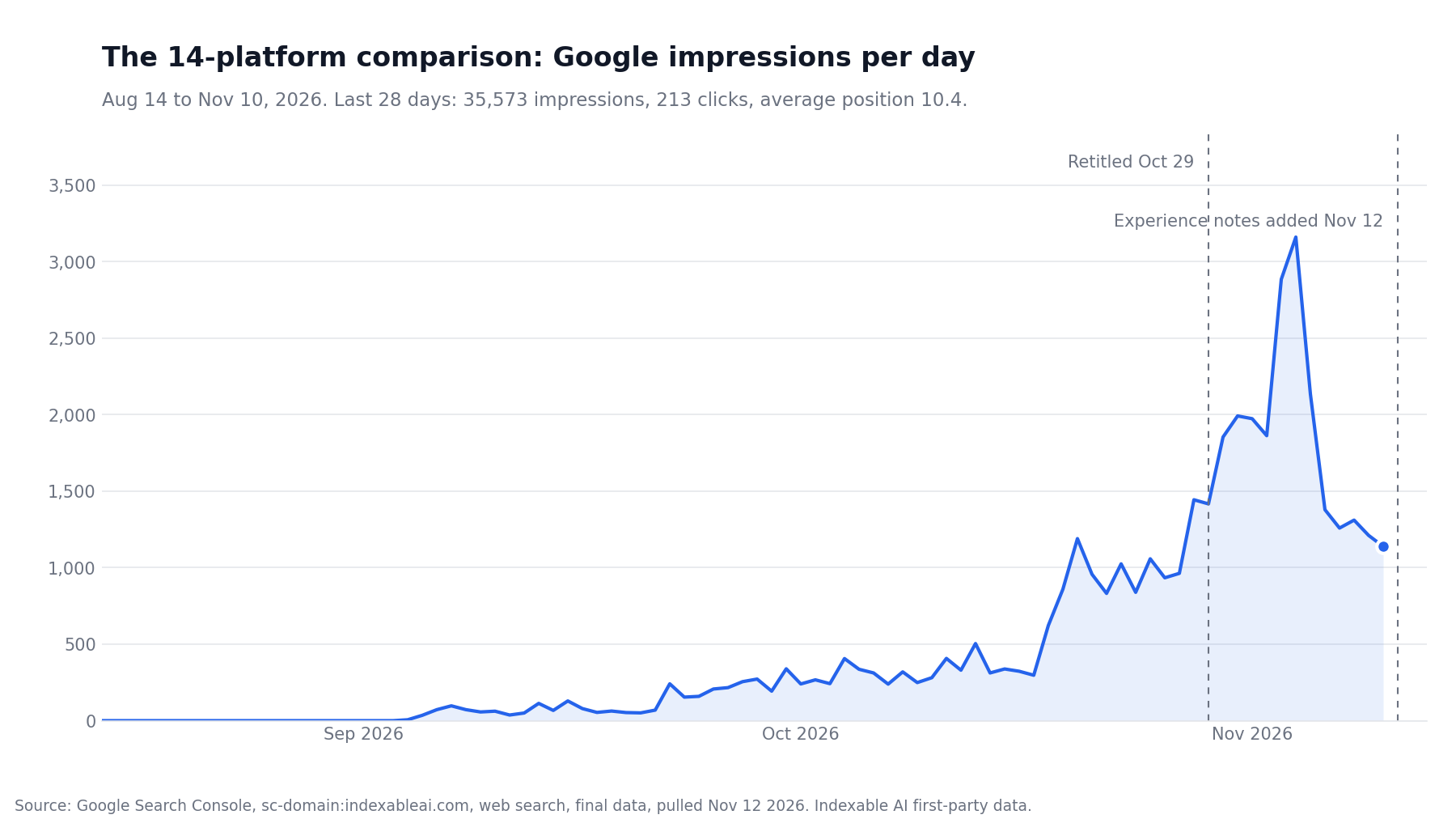
We measured this on our own page. In the 28 days to October 6, 2026, Google Search Console recorded 720 distinct queries returning this page (4,723 impressions, 2 clicks, average position 17.2 — an impression-weighted average, not a rank). 503 were full sentences of eight or more words, and most look machine-made: 161 carried persona or “context: location: …” wrappers typical of automated prompt runners, and only one passed our human-like test (10+ impressions, under 90% desktop). The people who reached the page typed short terms: the 24 human-like queries drew 1,988 impressions, led by “enterprise seo platform” (683) and “enterprise seo platforms” (300). Read the long questions as how AI tools phrase this topic, not as demand.
- “what are the best enterprise seo platforms in 2026?” (human-like)
- “how much do generative engine optimization platforms cost compared to seo suites?” (fewer than 10 impressions)
Source: Indexable AI first-party Google Search Console data for this URL, 2026-09-09 to 2026-10-06, n = 720 queries (anonymized queries excluded, so query counts are a floor), pulled October 10, 2026.
Changelog. November 12, 2026: first-person experience notes added to the opener and three sections. November 9, 2026: author credentials added to the byline and methodology. November 7, 2026: Indexable AI named in full throughout, one fit section replaces the two self-assessment paragraphs, price chart and structured-data updates added. Earlier: October 29 retitle and the companies-versus-agencies section; October 28 CMO shortlist and ROI FAQ; October 10 enterprise SEO software definition and refreshed Search Console data; September 20 rebuilt from 8 to 14 platforms; September 3 first published.
Related reading: what enterprise SEO costs · enterprise SEO ROI · audit checklist · AI visibility platforms buyer’s guide · Profound alternatives · what is an AI SEO agent. · Enterprise SEO services, agencies and consultants: costs and how AI agents compare
Compare us against your own data
See where your brand stands across the major AI engines.
All trademarks are the property of their respective owners. Indexable AI is not affiliated with, endorsed by, or sponsored by any company named on this page. All comparisons reflect publicly available information as of the date shown.